Wednesday, January 7, 2009

Lesser Flamingos, Lake Nakuru, Kenya

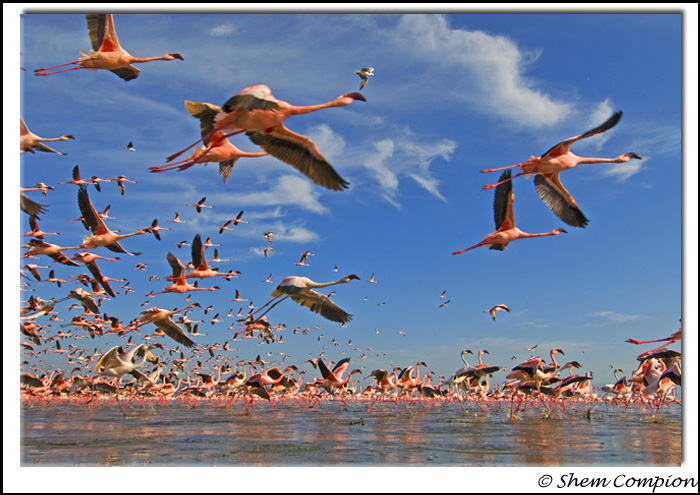
Lake Nakuru has to be one of the most inspiring birding spectacles in the world. 60 000 thousand flamingos are a sight to behold. The noise, the smell and the constant movement and motion all combine to attack the senses in one large flock. I recently spent three nights with clients at this wonderful venue, with the express purpose of capturing these, and the many other birds here, in all their beauty.
essay-41

Now that may sound like a simple thing to do- 60 odd thousand birds are more than enough subjects to fill a camera: Nevermind spending three days there. Well, it’s not as easy as that. These birds just don’t leave each other alone! The old phrase of “safety in numbers” is very true with these birds. They are very wary of any approach and tend to huddle together as more disturbance comes along. The best method of approach is that of patience. In the 30-degree heat on an open mud flat, that can be quite a task! However, we persevered through the heat and discomfort and all managed to come home with some fairly stonking images.

It has to be said though; Nakuru has not been all good news for the last few years. Only after flamingo numbers drastically dropped, did the Kenyan Wildlife Services start doing something about the problem. I wont go into it here, but expect a blog entry about it soon- as I consider the Flamingo a great indicator species. Happily though the numbers are back and tourists can enjoy these fantastic birds.

It was day two and we had used three sessions to photograph flamingos. The problem with a constant subject (and the beauty) is that things get more difficult as you go along. You get all the standard images, review your work, take some better ones of what you did before and then realise that you now have to push a few limits. You become very fussy; watching backgrounds, waiting for a specific neck turn, a beak in water, a flap of a wing- anything to make your images more unique. To say that flamingos are difficult subjects is an understatement; but when an image comes off, well, it really comes off well, as these birds really do shine in good light. As I said in a before in a blog entry- 60 000 birds and 60 000 shades of pink!

We had spent the morning at the fresh water inlet of the lake. The birds come here to drink and bathe, so we knew the concentrations here would be high. After a few standard images I needed to get something different. So I pulled out the wireless remote, put it on the D200 which was attached to the 12-24mm lens, propped it onto a gorilla pod and walked out to the edge of a spit. I had “dry” tested the remote up to 80m. So I walked away from the camera and waited in the vehicle about 80m away. Slowly, the birds waded closer, and closer and closer. I was snapping with the remote release in the shade of the vehicle and starting to enjoy this relaxed manner of photography. Suddenly, 400m away, a hyaena ran into the birds, searching for a dead carcass. This caused pandemonium amongst the birds. I would guess 5000 birds flew right towards us and right over our heads. A sight to behold! I was snapping the remote as fast as I could while using the other camera with a longer lens.

The birds all departed and the hyaena did not have any success, but it did see my camera at the waters edge. All of a sudden it became a race to the camera. The hyena led with his teeth and jaws; I chased in with a client’s monopod! It all ended happily, as the hyeana decided to leave the scene. I picked up the camera and walked back to the vehicle- eagerly wanting to see what had been captured.

You can imagine my surprise when it only had one image recorded! I was flabbergasted - the only image was one taken right in the middle of the action, when all the birds were flying overhead. I don’t know how it happened, but I’m not asking any questions.

What came out was an image of thousands of flamingos flocking towards us. I had been looking for a different perspective for a while - I think I now have one.

For more info on going on a Photo workshop to improve your photography, visit C4 Images & Safaris.

Exposure information:
Nikon D200 - 12-24mm lens
Exposure - f 9
Shutter Speed: 1/750sec
Exp. Comp. : + 0.3 EV
ISO - 250
Flash sync - not attached, Exposure mode - Aperture priority, Metering Mode - centre weighted
File type - NEF (RAW)
Focal length: 12mm (18m @35mm equivalent)
Gorilla pod, remote release

This article first appeared on shemimages.com

Shem Compion Read more!

Monday, January 5, 2009

White Faced Ducks - Austen Roberts

Being close to home for a while makes the feet itch. That may sound like a strange statement, but it is straight talking about what drives me. I like to be “out there”, smelling the fresh, dusty air and reviving the senses with a fresh winters chill on the cheeks as the Land Rover bumps along a single track through the bush. To be honest, that is exactly what drives me, and as tired as I can be at the end of a hard day photographing- up at 4h30, back in camp to talk photography and discuss post processing and then heading out back at 15h30 and dinner till the camp is dead quiet and every one is sleeping- I wake up ready to do it all again with a very certain verve the next morning. It’s as simple as that.

essay-40-1


So when I have an extended session back in town- the feet start to itch. For some that may mean mischief, but for me that means I need to get the cameras out again.
Luckily, close to where I live there are some very nice places to photograph. One of those places is the Austin Roberts bird park.
Firstly, Austin Robert’s the person. South Africa’s Audubon, Austin Roberts was a director of the Transvaal Museum of natural history. A great affinity for birds, Roberts’ spent most of his adult life collecting and identifying birds for identification and taxonomic purposes. The result- the definitive bird identification reference guide on the birds of southern Africa. Roberts’ bird book is now in its 8th edition and many avid birders will fondly tell you of their first tattered and abused “Roberts”.

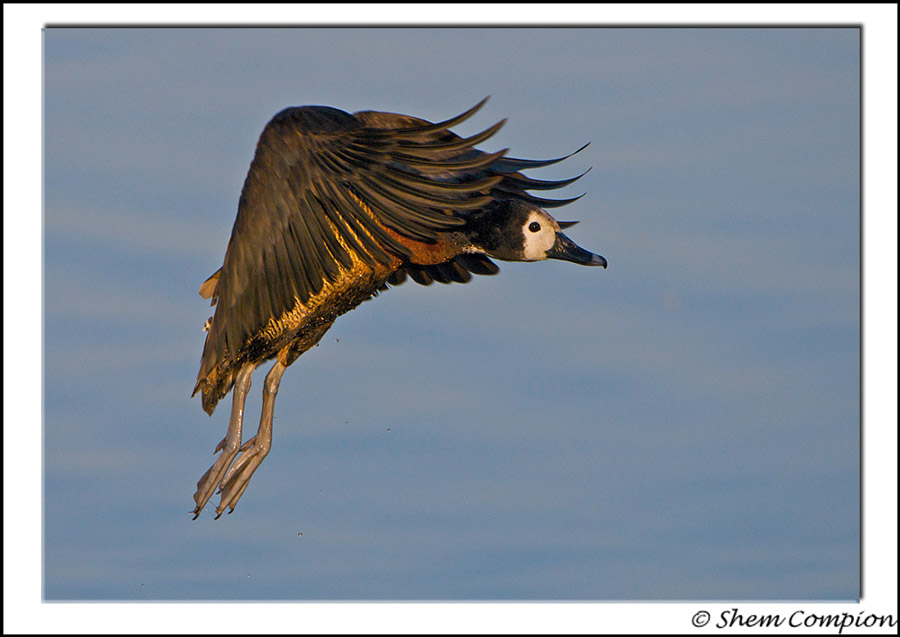
So the park is named after Austin Roberts and of course there are birds there to photograph. White-faced ducks, in their musical collectiveness make up the numbers amongst a few other species. So having itchy feet, I spent a few mornings here working on technique and specific settings. The first instinct with bird photography is to get the bird as pin sharp as you can. This involves setting a high shutter speed to freeze every detail. The result is something as in image 1 of the essay.
However, once a certain type of standard image is captured, I always look for something new and different. And so it was that I went to Austin Roberts each morning with a different mission.
To capture motion.
This proved harder to do than perceived and in doing so I noticed just how much these birds move their heads when they fly. It made me study their heads as they fly and in doing so, I noticed that they keep their head very still as they are landing. So I set up to catch them when doing so.
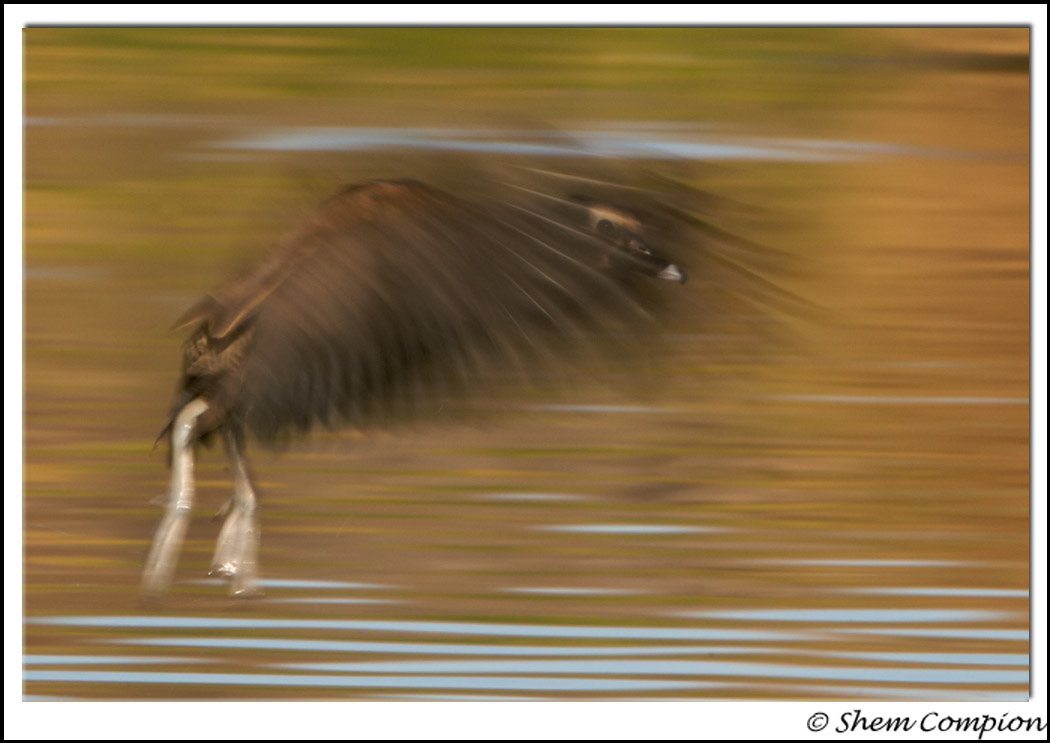
Eventually I managed to capture an image that portrays the effect I had in mind. (See image 2) A motion of wings and feathers that shows more ephemeral movement than any detail could ever do. And that is just what photography is to me. Fleeting, beautiful and descriptive all at once.
Right near home I managed to rid the itchy feet by watching and observing birds and then photographing them- I’m sure Austin Roberts would have been proud…!

essay-40-2

For more info on going on a Photo workshop to improve your photography, visit C4 Images & Safaris.

Exposure information
Image 1
Nikon D300 - 200-400mm lens
Exposure – f 5.6 Shutter Speed: 1/1600sec
Exp. Comp. - 0.3 EV
ISO - 640
Flash sync– not attached, Exposure mode– Aperture priority, Metering Mode– centre weighted File type– NEF (RAW)
Focal length: 460mm (690mm 35mm Equivalent)
Tripod

Image 2
Nikon D300 - 200-400mm lens
Exposure – f 25 Shutter Speed: 1/60
Exp. Comp. - 0.3 EV
ISO - 400
Flash sync– Fired- rear curtain sync, Exposure mode– Shutter priority, Metering Mode– Matrix. File type– NEF (RAW)
Focal length: 380mm (570mm 35mm Equivalent)
Tripod

This article first appeared on shemimages.com

Shem Compion

Read more!
Sunday, January 4, 2009

Lion Chase - Deception Valley, Botswana

To be frank, I don’t really enjoy photographing lions. They are the laziest animals around, always sleeping, always snoozing and useless for any decent photography.
The problem is that every person who has ever been to Africa has a photo of a lion, well actually many photos of lion, even if they had only one sighting!

I’ve often wondered which lion is the most photographed, as in with a model. In certain National parks, a sleeping lion can cause traffic jams of over 20 vehicles with 4 cameras in each, snapping off enough photos to make a model on a Parisian catwalk smile! The results? You guessed it: sleeping lions. Of course I was once like that too, but looking at all the other good lion images out there, I was always aware of what the standard of photography was.I now have a decent collection of lion images- some of them actually doing things.., but when I head out into the bush, Lions aren’t exactly on the top of my agenda, cause I know there are so many good images out there.

essay-38

Deception valley in the Central Kalahari is a different kind of place. For most parts of the year, it is a dry dust bowl with nothing much around. Some animals and birds, but nothing compared to the late rainy months: Which exactly where I was on a photo tour in early March. And what a tour it was- the Kalahari was at its most beautiful; with short grass attracting herds of animals and birds displaying and lions everywhere,literally.
Speaking of lions, we actually witnessed some brilliant Lion behaviour.
We had two male lions in a brawl, chasing each other across the grassy fields, roaring and scent marking right next to our vehicles. An amazing experience to say the least!
That evening we found 8 lions just in front of our camp and the next morning we found them in the grassy valley 2km from camp. We picked them up just before sunrise. They were not quiet ready for doing nothing, in fact they were quite active and full of beans, just what photographers look for.
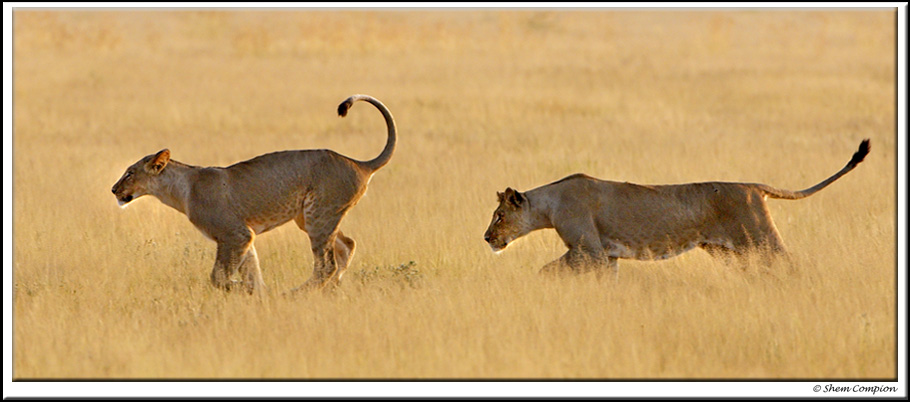
For the next 20 minutes, as the sun glowed through the clouds, the lions played, ran and fought on the open valley floor. It was photographic bliss and one of the few times where lions go from party poopers to front of house entertainers, deluxe.
A Parisian model would have been taught a lesson or two here. I suppose it makes up for all the times we watch lions sleeping on the road.
The law of averages was at play.

Just be out there.

For more info on going on a Photo workshop to improve your photography, visit C4 Images & Safaris.

Exposure information
Nikon D200 – 200-400mm, 1,4 convertor
Exposure – f 6,3 Shutter Speed: 1/500sec
Exp. Comp. 0 EV
ISO equiv. - 250
Flash sync– not attached, Exposure mode– Aperture priority, Metering Mode– Matrix, File type– NEF (RAW)
Focal length: 560mm (840mm, 35mm eqivalent), Tripod

This article first appeared on shemimages.com

Shem Compion Read more!
Black Bellied Bustard Display - Lebala, Botswana

It had been a chilly afternoon drive. A Mid-day thunderstorm had struck and drenched the whole area, leaving behind it a trail of mud, dripping trees and dark clouds hanging in the sky. The game drive had been one where you could feel the rain in the air- a hippo even deemed it fresh enough to leave the sanctity of the water and head into the open floodplain to graze. We locked onto him and naturally had a field day with the cameras- especially as there were egrets, herons and about three other bird species feeding in his wake. But it was quite dull- the light was one stop under what it would be to give the scene a nice glow. So we moved on- driving slowly in the cool fresh air, rain ponchos keeping the wetness out.

essay-39

November in Southern Africa is the start of the breeding season for most bird species. Thus, from a natural history point of view, it is a great time to travel here. From a photo safari point of view too, this is one of the most exciting seasons, as young animals are being born and birds and animals are alike are either breeding or giving birth. The morning chorus is full of the joys of life and it’s probably the only time I can say that I can “hear the excitement of the Bush”.

And so it was that we came across this Black bellied bustard (Korhaan) atop a termite mound calling out to any females that would listen. It is great courtship behaviour to watch, as they extend their necks and emita very slight “Pop” at the height of their neck extension.
Our group, however, was more interested in catching the action, as the light had just peaked from under the clouds. After the first front-lit shots, we moved around him: as the clouds were taking on a special colour and hue from the sunset. The Bustard, not to be outdone, stood his ground and continued his calling- deep in the throes of courtship.
The bird continued calling and the light just got better. Eventually we had enough. We just could not take another image of a bird calling against a stunning backdrop.

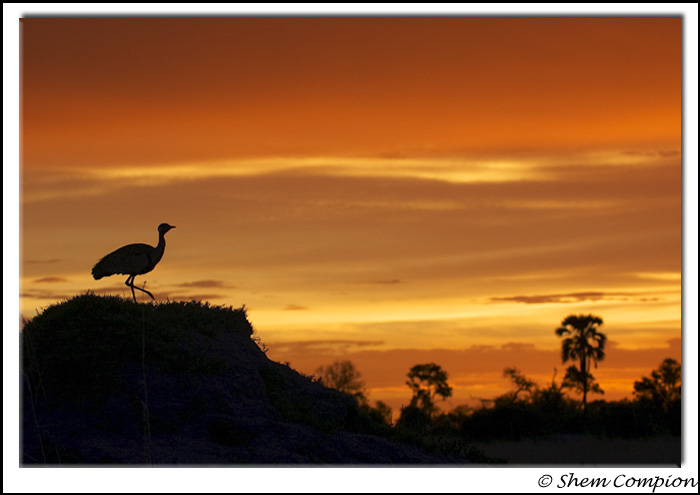
Until that is, it decided to leave us… With the backdrop of the Palmtrees in the Linyanti, I decided to shoot wider and zoomed out to incorporate the whole environment. All of a sudden the whole scene took on another feel, especially with that odd, stalking gait that a bustard has silhouetted against a colourful Okavango sky.

That is the image that made it to this Essay- a fitting end to a grand show.

For more info on going on a Photo workshop to improve your photography, visit C4 Images & Safaris.

Exposure information:
Nikon D70 - 70-200mm lens
Exposure – f 5.6 Shutter Speed: 1/200sec
Exp. Comp. - 0.3 EV
ISO - 200
Flash sync– not attached, Exposure mode– Aperture priority, Metering Mode– centre weighted File type– NEF (RAW)
Focal length: 116 mm (174mm 35mm Equivalent)
Handheld

This article first appeared on shemimages.com

Shem Compion Read more!
Saturday, January 3, 2009

Dune scale - Dead Tree pan, Sossusvlei

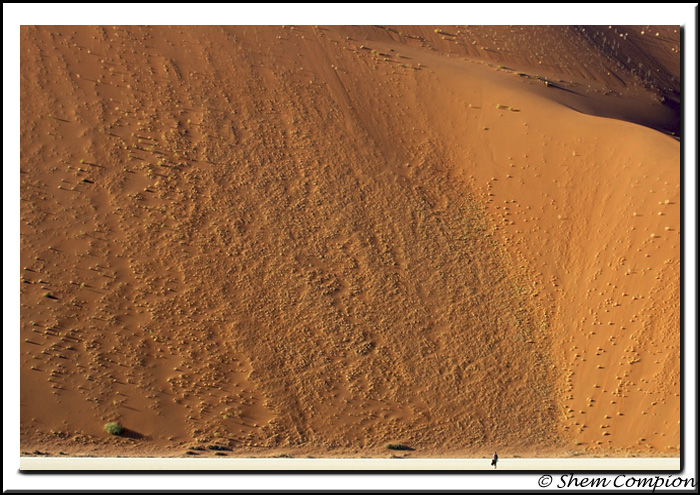
Scale is a relative term. We, as humans love to measure and compare things. How large our house is, how fast our cars are, how many times we hit a ball, the list goes on and each comparison is measured against a previous encounter, an average, or “how the pros do it”. It gives us a level of accomplishment, or something to achieve towards. We use scale to measure our performance at work, home and play. And most times, it just puts things into perspective.

Thus I found myself in Dead tree pan, at Sossusvlei in Namibia. If you have been there, you will know it as one of the most hauntingly beautiful places on earth. The silence at first light is astounding and the dead acacia trees splay their arms heavenwards in a silent grieving. Four of us were there at dawn. Within a few minutes, of arriving each of was alone- that is how easily the large pan swallows you up, as you are trying to contemplate how to capture such a serene scene.

essay-37


An hour after sunrise the first tourists arrives. The walk across the dunes to get here is long and they aren’t necessarily as obsessively dedicated as photographers who race there at dawn… However, it also means that people are walking into your images, so its time to pack up, the work is done for the day. In doing so, I noticed a tourist walking in the distance of the pan, against the backdrop of the southern dunes. Immediately I was aware of how small he was in relation to the dune. Out came the camera and then this image. All morning I had been trying to capture and show the beauty of the pan, but sometimes it is hard to capture a scene without something to relate to. The human factor in this image just added that extra scale to the image.

As I said, scale is a relative term, but sometimes, it just puts things into perspective.

For more info on going on a Photo workshop to improve your photography, visit C4 Images & Safaris.

Exposure information:
Nikon D70 - 70-200mm
Exposure – f 11 Shutter Speed: 1/160sec
Exp. Comp. 0 EV
ISO equiv. - 200
Flash sync– not attached, Exposure mode– Aperture priority, Metering Mode– Matrix, File type– NEF (RAW)
Focal length: 100mm (150mm, 35mm equivalent)
Hand held

This article first appeared on shemimages.com

Shem Compion

Read more!
Interior Photographer in South Africa

If you're a hotelier or the owner of a bed and breakfast, you undoubtedly want your guests to feel warm and welcome and you will want them to leave with lasting impressions, so when you advertise your place in a glossy magazine or on the Internet, an interior photographer in South Africa can play a significant role in conveying your desired message of utter comfort to your patrons. Image is everything when seeking to retain existing patrons or new ones, and great original photos by an interior photographer in South Africa can inform and excite, while creating the confidence to book yourself in to such an establishment.

Ideally, a person should be able to imagine themselves using the bedrooms, bathrooms and lounges visually presented by photographs,because the interior photographer in South Africa aims to communicate high quality colour, texture and other detail, as well as the effects of both natural and artificial light within the environment to make it look inviting.

With 2010 soccer world cup just around the corner, many hotels and lodges are busy undergoing refurbishments, and the demand for outstanding and original hotel and game lodge photography is increasing dramatically.

Learning to photograph the lodge or hotel in its environment, and getting to grips with understanding how to create stunning pictures of bedrooms and bathrooms to turn prospective patrons into regular guests,can get you started on becoming an interior photographer in South Africa, because at C4 Images and Safaris, thoroughly exciting courses are offered to enable you to create photographs with a higher visual impact and appeal, and already with only one course you will improve your images significantly, and who knows, before you know it your photo's could be used for websites as well as in popular glossy magazines and other printed media! So contact C4 Images and Safaris.

Related Articles:
* Aerial Photographer in South Africa
* Commercial Photographer
* Interior Photographer
* Lodge Photographer
* Professional Photographer


This article first appeared on C4 Images and Safaris.

Read more!

Commercial Photographer

A commercial photographer knows that apart from a thorough understanding of camera operation, lighting,composition, lenses, filters and the special properties of films and papers; it's the creation of a skillful photograph that will respond to the needs of the client. The commercial photographer is more critical and focused because you are not clicking pictures to satisfy your creativity, but rather to a target audience whom you need to please.

Photographers may specialize in portrait, news, industrial, medical, or scientific photography, or they may generalize in a combination of two or more types of photography, but the primary differences lie in the subject matter, work site, type of equipment used, and the amount of precision required for design and composition of the photograph. Commercial photographers take pictures of merchandise, architecture,and scenery for advertising and sales purposes.

Producing a stunning and successful picture requires choosing and presenting a subject to achieve a particular effect and then these are used in a variety of media, including books, reports, advertisements, and catalogues; the simple fact is that the best commercial photographers can do wonders for your business or advertising efforts with brilliant commercial photography, because people look at the pictures on a brochure or calender and make judgements in seconds according to what they see!

C4 Images and Safaris provide an unparalleled selection of photos allowing you to get get up close and personal with your favorite species, and a good deal of our photos can be reviewed in our on-line photo gallery where you will find an amazing array of things found in nature, including birds, bugs, landscapes, as well as colourful pictures depicting the people and the cultures of Africa and Madagascar, so whether you need a photograph for brochures or web sites, you get what you really want because C4 Images and Safaris helps those who demand quality and service.

Related articles:
* Aerial Photographer in South Africa
* Commercial Photographer
* Interior Photographer
* Lodge Photographer
* Professional Photographer


This article first appeared on C4 Images and Safaris

Read more!

Friday, January 2, 2009

Cattle Egret Flight - Ampijoroa, Madagascar

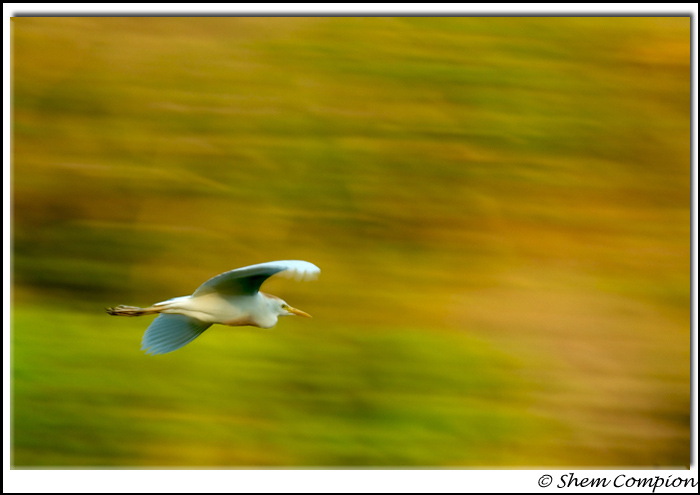
In terms of wildlife, Madagascar is a marvel of the modern world. As with many islands, the wildlife is quite unique as the fauna and flora have had many millions of years to evolve on their own. Thus we have islands such as The Galapagos, The Falklands, Borneo, Papua New Guinea and of course Madagascar. Of all the islands on earth, Madagascar is perhaps the one with the highest total endemic species of flora and fauna combined. What makes it so interesting though, is that species are still being discovered and described as I write this! Speaking to researchers in Ampijoroa about their subjects, I was astounded to hear that they were doing studies on subjects that were done on most other animals more than 30 years ago. You can literally point your camera at any subject and produce a thesis on its behaviour, such is the lack of knowledge on many of the species. I have travelled far and wide photographing nature and wildlife, but nowhere have I come across nature guides who describe the species by their scientific names. At first I was quite impressed by their intimate knowledge of the various species, but then I learnt that for many of the species, there is no common name, hence the vernacular being in Latin!

essay-33


So as you can imagine, photographing in Madagascar is quite a treat. New species are almost around every corner. The lemurs and Sifakas add the charismatic appeal that no one can ignore, while the chameleons, frogs and leaf tailed geckos provide a level of fascination I never thought possible for the smaller creatures of this world. Then there are the birds, tenerics, snakes and lastly the unique, out-of-this-world specialities such as the Eye-eye. An animal so diverse in its looks that all I can say is that the wildebeest has nothing on it at all!

Arriving in Ampijoroa, a dry deciduous forest on the north west of the island, we were greeted to a cacophony of birds and sifakas. Everywhere you looked were endemic birds parading in the spring weather, preparing for the onset of the breeding season. I photographed many of the birds there, but what really caught my attention was the breeding colony of the common Cattle egret just in front of our campsite. Approximately 300 birds were nesting in some reeds over the Ravilobe Lake and in doing so, providing some excellent photographic subjects. Thus I spent a morning or two photographing these very common birds. You see, even in a place as unique as Madagascar, when a subject presents itself in excellent light, you take advantage of the situation; even if it is the lowly common cattle egret that occurs throughout Africa.
I hope you agree.

For more info on going on a Photo workshop to improve your photography, visit C4 Images & Safaris.

Exposure information:
Nikon D200 - 70-200 and 1.4 converter
Exposure – f 18 Shutter Speed: 1/20sec
Exp. Comp. -0.7 EV
ISO equiv. - 125
Flash sync– not attached, Exposure mode– Shutter priority, Metering Mode– Matrix, File type– NEF (RAW)
Focal length: 280mm (420, 35mm equivalent)
Hand held

This article first appeared on shemimages.com

Shem Compion

Read more!